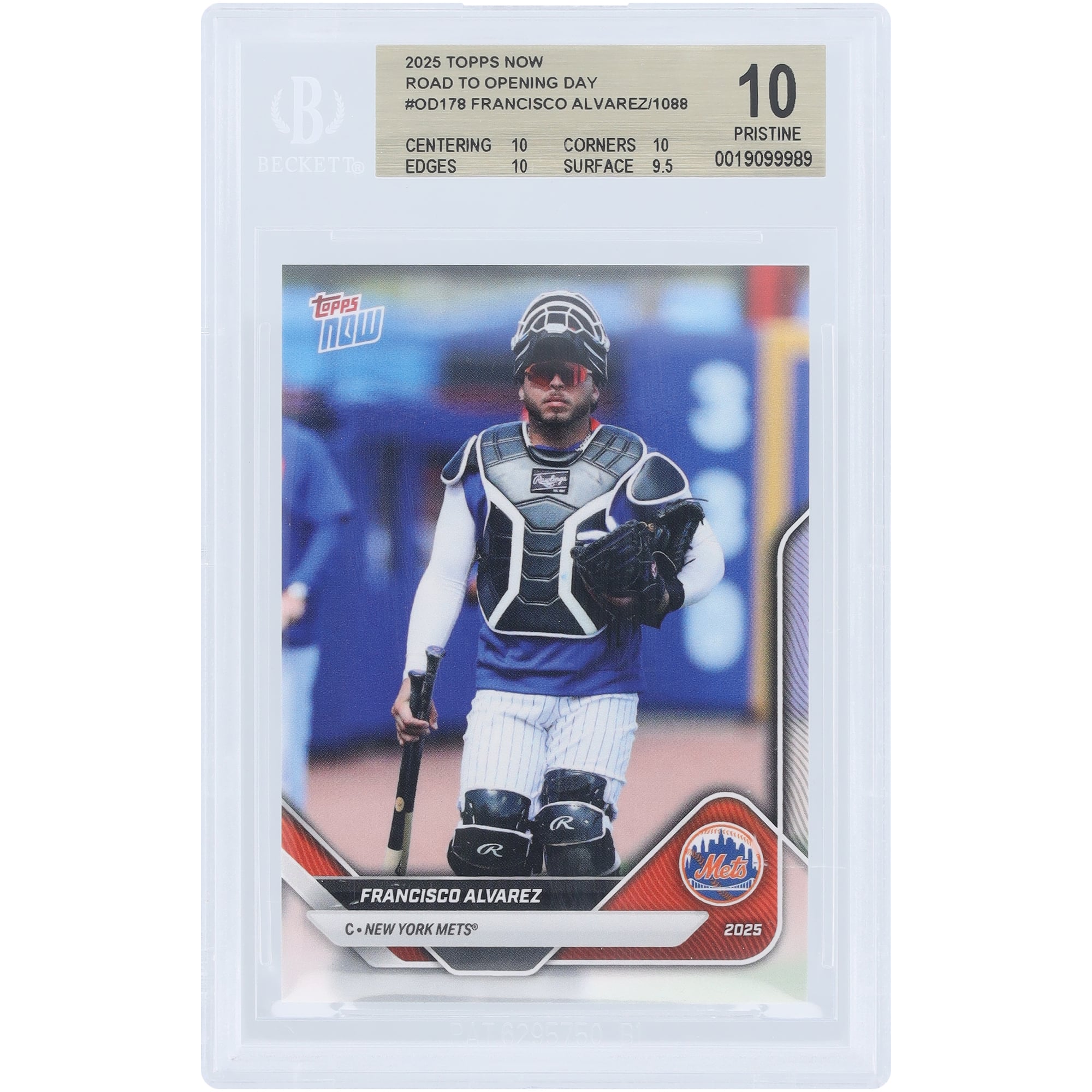
On July 16, 2026, the New York Mets beat the Philadelphia Phillies 4-1 in Philadelphia, and Francisco Alvarez personally supplied at least half of that scoring. The Mets' 24-year-old catcher hit two home runs in the same game, a burst of power that stands out sharply against a season where he's managed 11 home runs across 65 games — and against a league-wide day where multi-homer games were the exception, not the rule.
Alvarez's two homers came against a backdrop where the average major leaguer who played on July 16 hit 0.25 home runs — meaning most players who connected for one didn't get a second, and plenty of players didn't hit any at all. Two in a single game gave Alvarez a z-score of 3.13 relative to that day's full population of hitters. Z-scores above 3.0 generally describe the top 0.1 to 0.3 percent of individual performances — the kind of outlier that shows up a handful of times across the entire league in a given season, not something that happens to a specific hitter more than once every few years.
What we can't say with the available data is exactly how hard Alvarez hit either ball — Baseball Savant's per-homer exit velocity and launch angle for this specific game weren't logged in what's on record here, so any claim about a 108 mph line drive or a towering fly ball would be guessing. What we do know is the broader shape of his season: an 11-homer, .448-slugging campaign through 65 games, built on a .259 average that's already 24 points higher than his career mark of .235 across 369 games. Two homers in one night, for a hitter on that trajectory, reads less like a fluke pitch sequence and more like a loud version of what he's already been doing — cashing in mistakes rather than reinventing his swing.
What we can't say with the available data is exactly how hard Alvarez hit either ball — Baseball Savant's per-homer exit velocity and launch angle for this specific game weren't logged in what's on record here, so any claim about a 108 mph line drive or a towering fly ball would be guessing. What we do know is the broader shape of his season: an 11-homer, .448-slugging campaign through 65 games, built on a .259 average that's already 24 points higher than his career mark of .235 across 369 games. Two homers in one night, for a hitter on that trajectory, reads less like a fluke pitch sequence and more like a loud version of what he's already been doing — cashing in mistakes rather than reinventing his swing.
Alvarez is 24 and still building his track record behind the plate, a position where two-homer games are simply rarer — catchers absorb more foul tips, more day games after night games, more of the physical toll that saps bat speed as a season wears on. His current .773 OPS is a real step up from the .235 average and 59 home runs he'd compiled over 369 career games before this season, and a two-homer night fits neatly into a year where the power has already been ticking upward. But one game is one game. A catcher can have a loud Thursday and a quiet next ten days, and nothing here confirms a permanent shift — it's one data point on a trend that was already pointing in this direction.
The number worth tracking over the next two weeks isn't the home runs — it's the strikeouts. Alvarez has struck out 61 times in 65 games this season, essentially once a game, and that rate will say more about whether this power is sustainable than any single night can. If the strikeout pace holds steady even as the extra-base hits keep coming, it's a sign he's simply started connecting on pitches he was already seeing well. If the strikeouts climb right alongside the power, July 16 starts looking more like two mistakes a pitching staff won't make again.
Either way, a 0.25-home-run day around the league just turned into an eight-fold night for one catcher in Philadelphia — the kind of gap the box score records but never quite explains.